
The global transition to electric vehicles is often described in terms of batteries—their range, their cost, their charging speed. But under the hood, a quieter, equally transformative revolution is taking place in the heart of every EV: the electric motor. The future of transportation is being shaped by a fierce technological race to build motors that are more powerful, efficient, and compact, pitting established giants like Tesla against ambitious Chinese champions like BYD and surprising new entrants like Xiaomi.
Beyond the Magnet: The Core Technologies Defining Performance
At the core of this battle are two dominant motor technologies, each with distinct advantages. The Permanent Magnet Synchronous Motor (PMSM), used by Tesla in its Model 3 and Y, and extensively by BYD, relies on powerful rare-earth magnets to create a dense magnetic field. This design offers exceptional power density and high efficiency, particularly at low to mid-range speeds, making it ideal for mass-market passenger vehicles. Tesla’s relentless optimization has pushed its PMSM to peak efficiencies of around 97%, meaning nearly all the electrical energy from the battery is converted into motion.
Challenging the PMSM’s dominance is the Induction Motor, a technology Tesla famously used in its Model S and X. While slightly less efficient at peak performance, induction motors are rugged, cost-effective as they avoid expensive rare-earth materials, and excel at high-speed, high-power performance. This makes them a perfect fit for performance-oriented vehicles and as a secondary motor in all-wheel-drive systems.
The real innovation, however, lies in how these technologies are being refined and combined. BYD has made a huge splash with its “8-in-1” e-Platform, which integrates the motor, gearbox, inverter, and vehicle control unit into a single, highly compact module. This integration reduces weight, saves space, and boosts overall system efficiency. Their signature Blade Battery is structurally integrated with this platform, creating a vehicle that is not only safer but also remarkably efficient.
The Data-Driven Advantage: Efficiency as the New Horsepower
The ultimate measure of a motor’s prowess is its real-world impact on vehicle efficiency, measured in watts per mile or kilometers per kilowatt-hour (kWh). Here, the progress is staggering.
- Tesla: The Tesla Model 3 RWD (equipped with a PMSM) has set a benchmark, achieving an EPA-estrated range of 272 miles from a 57.5 kWh battery, translating to an industry-leading efficiency of about 4.1 miles/kWh.
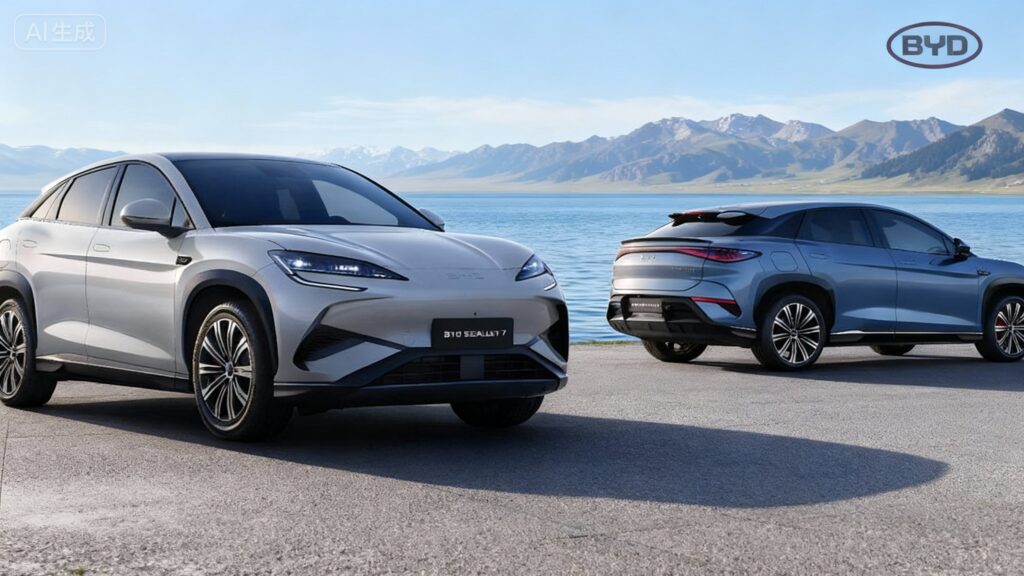
- BYD: The BYD Seal, a direct Model 3 competitor, boasts a similarly impressive consumption rate of around 12.7 kWh/100km, which is roughly equivalent to 4.9 miles/kWh, showcasing its highly optimized powertrain.
- Xiaomi: The new entrant has stunned the industry with the reveal of its SU7 sedan. Xiaomi’s self-developed HyperEngine V6s motor boasts a staggering rotational speed of 21,000 rpm, a figure that rivals the most advanced motors on the market. High rpm allows for more power without increasing size and weight, directly contributing to the SU7’s claimed 0-100 km/h time of 2.78 seconds and a top speed of 265 km/h.
This focus on motor efficiency is the primary driver behind the rapidly falling costs of EV ownership. A more efficient motor draws less energy from the battery for the same distance, allowing automakers to use smaller, cheaper battery packs to achieve a competitive range. This is a key reason why BYD has been able to launch models like the Seagull at an aggressively low price point, making EV ownership accessible to millions.
The Future is Integrated, Scalable, and Silicon-Carbide Powered
Looking ahead, three key trends will define the next generation of EV motors:
- The Rise of Silicon Carbide (SiC): The shift from traditional silicon to SiC in power inverters is a game-changer. SiC chips switch electricity far more efficiently, especially at high voltages, reducing energy loss as heat. Tesla’s Model 3 was a pioneer in using SiC, and its upcoming powertrains are expected to leverage this technology even further to achieve efficiency gains. BYD and other Chinese brands are rapidly adopting SiC to enable 800-volt architectures, allowing for blisteringly fast charging speeds.
- Motor and Reducer Integration: The future is not just about the motor alone, but its seamless integration with the gear reducer and inverter. This “3-in-1” or even “8-in-1” approach, as championed by BYD, reduces size, weight, and parts count, leading to higher reliability and lower manufacturing costs. This modular philosophy allows platforms to be scaled across an entire brand’s lineup, from compact cars to large SUVs.
- The Rare-Earth Dilemma and Material Science: Geopolitical and environmental concerns around rare-earth minerals are pushing R&D toward alternative designs. Tesla announced a strategic shift to a permanent magnet-free motor for its next-generation platform. This likely points to an advanced switched reluctance motor, which could reduce dependency on supply chains dominated by China and lower costs even further.
Conclusion: An East-West Tech Cold War Heats Up
The race for EV dominance has evolved into a race for motor supremacy. Tesla, with its vertical integration and audacious goals, continues to push the boundaries of performance and now, supply chain independence. Chinese giants like BYD have demonstrated a formidable ability to innovate for mass production and extreme cost-effectiveness, leveraging their integrated supply chains. Meanwhile, tech titans like Xiaomi are proving that their expertise in electronics, software, and high-speed manufacturing can be rapidly translated into world-class automotive powertrains.
The result is a global “tech cold war” where the electric motor is a primary battlefield. The winner will not only capture the world’s largest car markets but will also set the technological standard for the clean transportation era. The motor, once a humble component, is now the kingmaker in the electric century.